 Prof Jonti Horner
There are few things more spectacular than a Grea t Comet. Whilst many comets continually grace our skies, the majority remai n far too faint to see with the naked eye. On average, a truly spectacular comet (a 'Great Comet') will come along every decade, or so. But comets are like busses - you can wait thirty years, and then two come along at once!< /p>
In the last few months, our skies have been graced by two comets that might well be considered to be the Great Comets of 2024 and 2025. Comet C/ 2023 A3 (Tsuchinshan-ATLAS) put on a fantastic show in late September and t hrough October last year, whilst C/2024 G3 (ATLAS) was spectacular in Janua ry this year, despite appearing to fall apart as humanity watched on.
But what ARE comets? Where do they come from? And how do they work? To lea rn the answers to these questions (and many more!), join UniSQ's Jonti Horn er to hear the story of "A Comet's Tale".
Prof Jonti HornerJonti fi rst became interested in astronomy at the age of five, after seeing the BBC TV programme ‘The Sky at Night’, and soon became an enthusiastic amateur a stronomer. He joined his local astronomical society in the UK, WYAS (the We st Yorkshire Astronomical Society) at the age of eight, and is currently ho noured to serve as the society’s honorary president. To pursue his dream of turning his hobby into a career, Jonti studied a Masters’ degree in Physic s and Astronomy at the University of Durham, before moving to the Universit y of Oxford to undertake his doctoral studies. Once his PhD was complete, J onti worked as a postdoctoral research fellow at the University of Bern and the UK’s Open University before moving to Australia in 2010 to work at UNS W. In 2014, he moved to Toowoomba, to join the University of Southern Queen sland, where he is now Professor of Astrophysics. His research ranges from the study of our own Solar system to the search for planets orbiting other stars, as well as trying to understand the different factors that could com e together to make one planet more or less suitable as a target in the sear ch for life beyond Earth.
Jonti has a regular weekly slot on ABC Radi o Queensland's Evenings show, talking about the latest in Space news, and h as appeared in Australian documentaries and on a variety of international p odcasts. He writes regular articles for The Conversation (https://theconvers ation.com/profiles/jonti-horner-3355/articles). In 2023, the Internatio nal Astronomical Union (IAU) chose to name an asteroid after him: (32520) J ontihorner - a small and unusually reflective object moving near the middle of the Asteroid belt.
Note: This will be an online pres entation, but members and guests are invited to join us at the Green Point Observatory to view on the big screen and engage in discussions over supper .
X-ALT-DESC;FMTTYPE=text/html:There are few things more spectacular than a Grea t Comet. Whilst many comets continually grace our skies, the majority remai n far too faint to see with the naked eye. On average, a truly spectacular comet (a 'Great Comet') will come along every decade, or so. But comets are like busses - you can wait thirty years, and then two come along at once!< /p>
In the last few months, our skies have been graced by two comets that might well be considered to be the Great Comets of 2024 and 2025. Comet C/ 2023 A3 (Tsuchinshan-ATLAS) put on a fantastic show in late September and t hrough October last year, whilst C/2024 G3 (ATLAS) was spectacular in Janua ry this year, despite appearing to fall apart as humanity watched on.
But what ARE comets? Where do they come from? And how do they work? To lea rn the answers to these questions (and many more!), join UniSQ's Jonti Horn er to hear the story of "A Comet's Tale".
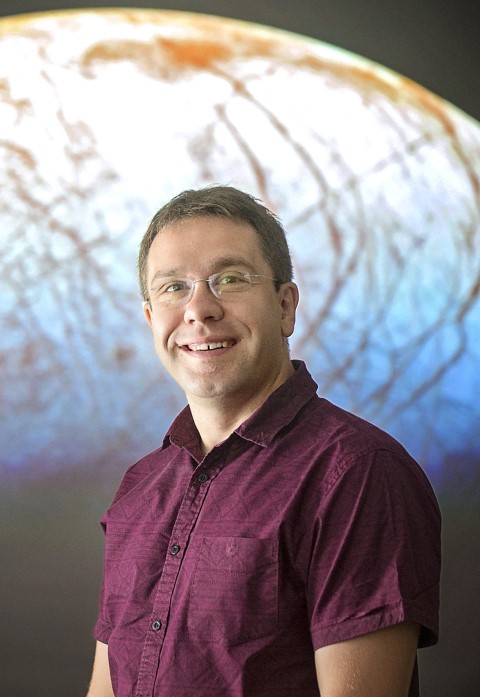 Prof Jont
i Horner
Prof Jont
i HornerJonti first became interested in astronomy at the age of fi ve, after seeing the BBC TV programme ‘The Sky at Night’, and soon became a n enthusiastic amateur astronomer. He joined his local astronomical society in the UK, WYAS (the West Yorkshire Astronomical Society) at the age of ei ght, and is currently honoured to serve as the society’s honorary president . To pursue his dream of turning his hobby into a career, Jonti studied a M asters’ degree in Physics and Astronomy at the University of Durham, before moving to the University of Oxford to undertake his doctoral studies. Once his PhD was complete, Jonti worked as a postdoctoral research fellow at th e University of Bern and the UK’s Open University before moving to Australi a in 2010 to work at UNSW. In 2014, he moved to Toowoomba, to join the Univ ersity of Southern Queensland, where he is now Professor of Astrophysics. H is research ranges from the study of our own Solar system to the search for planets orbiting other stars, as well as trying to understand the differen t factors that could come together to make one planet more or less suitable as a target in the search for life beyond Earth.
Jonti has a regular weekly slot on ABC Radio Queensland's Evenings show, talking about the lat est in Space news, and has appeared in Australian documentaries and on a va riety of international podcasts. He writes regular articles for The Convers ation (https://theconversation.com/profiles/jonti-horner-3355/articles). In 2023, the International Astronomical Union (IAU) chose to name an aster oid after him: (32520) Jontihorner - a small and unusually reflective objec t moving near the middle of the Asteroid belt.
Note: Thi s will be an online presentation, but members and guests are invited to joi n us at the Green Point Observatory to view on the big screen and engage in discussions over supper.
DTSTAMP:20261021T040006 DTSTART;TZID=Australia/Sydney:20250807T193000 DTEND;TZID=Australia/Sydney:20250807T213000 SEQUENCE:0 TRANSP:OPAQUE END:VEVENT END:VCALENDAR