BEGIN:VCALENDAR
VERSION:2.0
PRODID:-//jEvents 2.0 for Joomla//EN
CALSCALE:GREGORIAN
METHOD:PUBLISH
BEGIN:VTIMEZONE
TZID:Australia/Sydney
BEGIN:STANDARD
DTSTART:20170404T193000
RDATE:20171001T030000
TZOFFSETFROM:+1100
TZOFFSETTO:+1000
TZNAME:Australia/Sydney AEST
END:STANDARD
BEGIN:STANDARD
DTSTART:20180401T020000
RDATE:20181007T030000
TZOFFSETFROM:+1100
TZOFFSETTO:+1000
TZNAME:Australia/Sydney AEST
END:STANDARD
BEGIN:STANDARD
DTSTART:20190407T020000
RDATE:20191006T030000
TZOFFSETFROM:+1100
TZOFFSETTO:+1000
TZNAME:Australia/Sydney AEST
END:STANDARD
BEGIN:STANDARD
DTSTART:20200405T020000
RDATE:20201004T030000
TZOFFSETFROM:+1100
TZOFFSETTO:+1000
TZNAME:Australia/Sydney AEST
END:STANDARD
BEGIN:STANDARD
DTSTART:20210404T020000
RDATE:20211003T030000
TZOFFSETFROM:+1100
TZOFFSETTO:+1000
TZNAME:Australia/Sydney AEST
END:STANDARD
BEGIN:STANDARD
DTSTART:20220403T020000
RDATE:20221002T030000
TZOFFSETFROM:+1100
TZOFFSETTO:+1000
TZNAME:Australia/Sydney AEST
END:STANDARD
BEGIN:STANDARD
DTSTART:20230402T020000
RDATE:20231001T030000
TZOFFSETFROM:+1100
TZOFFSETTO:+1000
TZNAME:Australia/Sydney AEST
END:STANDARD
BEGIN:STANDARD
DTSTART:20240407T020000
RDATE:20241006T030000
TZOFFSETFROM:+1100
TZOFFSETTO:+1000
TZNAME:Australia/Sydney AEST
END:STANDARD
BEGIN:STANDARD
DTSTART:20250406T020000
RDATE:20251005T030000
TZOFFSETFROM:+1100
TZOFFSETTO:+1000
TZNAME:Australia/Sydney AEST
END:STANDARD
BEGIN:STANDARD
DTSTART:20260405T020000
RDATE:20261004T030000
TZOFFSETFROM:+1100
TZOFFSETTO:+1000
TZNAME:Australia/Sydney AEST
END:STANDARD
BEGIN:STANDARD
DTSTART:20270404T020000
RDATE:20271003T030000
TZOFFSETFROM:+1100
TZOFFSETTO:+1000
TZNAME:Australia/Sydney AEST
END:STANDARD
BEGIN:STANDARD
DTSTART:20280402T020000
RDATE:20281001T030000
TZOFFSETFROM:+1100
TZOFFSETTO:+1000
TZNAME:Australia/Sydney AEST
END:STANDARD
BEGIN:DAYLIGHT
DTSTART:20171001T030000
RDATE:20180401T020000
TZOFFSETFROM:+1000
TZOFFSETTO:+1100
TZNAME:Australia/Sydney AEDT
END:DAYLIGHT
BEGIN:DAYLIGHT
DTSTART:20181007T030000
RDATE:20190407T020000
TZOFFSETFROM:+1000
TZOFFSETTO:+1100
TZNAME:Australia/Sydney AEDT
END:DAYLIGHT
BEGIN:DAYLIGHT
DTSTART:20191006T030000
RDATE:20200405T020000
TZOFFSETFROM:+1000
TZOFFSETTO:+1100
TZNAME:Australia/Sydney AEDT
END:DAYLIGHT
BEGIN:DAYLIGHT
DTSTART:20201004T030000
RDATE:20210404T020000
TZOFFSETFROM:+1000
TZOFFSETTO:+1100
TZNAME:Australia/Sydney AEDT
END:DAYLIGHT
BEGIN:DAYLIGHT
DTSTART:20211003T030000
RDATE:20220403T020000
TZOFFSETFROM:+1000
TZOFFSETTO:+1100
TZNAME:Australia/Sydney AEDT
END:DAYLIGHT
BEGIN:DAYLIGHT
DTSTART:20221002T030000
RDATE:20230402T020000
TZOFFSETFROM:+1000
TZOFFSETTO:+1100
TZNAME:Australia/Sydney AEDT
END:DAYLIGHT
BEGIN:DAYLIGHT
DTSTART:20231001T030000
RDATE:20240407T020000
TZOFFSETFROM:+1000
TZOFFSETTO:+1100
TZNAME:Australia/Sydney AEDT
END:DAYLIGHT
BEGIN:DAYLIGHT
DTSTART:20241006T030000
RDATE:20250406T020000
TZOFFSETFROM:+1000
TZOFFSETTO:+1100
TZNAME:Australia/Sydney AEDT
END:DAYLIGHT
BEGIN:DAYLIGHT
DTSTART:20251005T030000
RDATE:20260405T020000
TZOFFSETFROM:+1000
TZOFFSETTO:+1100
TZNAME:Australia/Sydney AEDT
END:DAYLIGHT
BEGIN:DAYLIGHT
DTSTART:20261004T030000
RDATE:20270404T020000
TZOFFSETFROM:+1000
TZOFFSETTO:+1100
TZNAME:Australia/Sydney AEDT
END:DAYLIGHT
BEGIN:DAYLIGHT
DTSTART:20271003T030000
RDATE:20280402T020000
TZOFFSETFROM:+1000
TZOFFSETTO:+1100
TZNAME:Australia/Sydney AEDT
END:DAYLIGHT
BEGIN:DAYLIGHT
DTSTART:20281001T030000
RDATE:20290401T020000
TZOFFSETFROM:+1000
TZOFFSETTO:+1100
TZNAME:Australia/Sydney AEDT
END:DAYLIGHT
END:VTIMEZONE
BEGIN:VEVENT
UID:277b81aebd174e2f342ae9d2c52af027
CATEGORIES:Guest Speaker Night
CREATED:20170824T200357
SUMMARY:Guest Speaker - Dr Lee Spitler - Macquarie University and AAO
DESCRIPTION:The Huntsman Telephoto ArrayI am really excited about my Huntsman observing
system, which uses off-the-shelf Canon lenses to see some of the faintest
galactic structures ever seen before. We can use this information to determ
ine the detailed growth history of galaxies. I am also leading efforts to l
aunch a similar system into space, which will map out nearly 13 billion yea
rs of cosmic history.\nDr Lee SpitlerSenior Lecturer, Macquarie University
and Australian Astronomical Observatory I led image analysis for the ZFOURG
E survey (http://zfourge.tamu.edu/), a 45-night campaign over 2 years on th
e 6.5-metre Magellan Baade telescope in Chile. We cataloged ~60,000 galaxie
s, including galaxies as far as 13 billion light years. This is the most pr
ecise study of the distant universe ever conducted. As a part of ZFOURGE, I
discovered one of the most distant galaxy clusters (https://arxiv.org/abs/
1112.2691). This fascinating galaxy "city" triggered a new observational ca
mpaign named ZFIRE (http://zfire.swinburne.edu.au/) using the 10-metre Keck
telescopes. We are looking for signs that the crowded environment of a gal
axy city impacted the galaxies within it. My PhD work focused on analysing
some of the best imaging ever taken of nearby galaxies from the Subaru and
Hubble Space Telescopes for the SLUGGS project (http://sluggs.swin.edu.au/)
. My imaging lead to the discovery of many thousands of globular star clust
ers, which we targeted with the Keck telescope to understand how much dark
matter is in these galaxies. Dr Spitler recieved a BSc with Honors in Comp
uter Science from the University of California, Santa Cruz, USA, and a PhD
in Astrophysics from Swinburne University, Melbourne, Australia\nIn 2015, D
r Spitler won the Macquarie University award for Research Excellence for Ea
rly Career Researcher, and was nominated as a finalist for a 2015 Eureka Pr
ize
X-ALT-DESC;FMTTYPE=text/html:The Huntsman Telephoto Array
I am really excited about my Huntsm
an observing system, which uses off-the-shelf Canon lenses to see some of t
he faintest galactic structures ever seen before. We can use this informati
on to determine the detailed growth history of galaxies. I am also leading
efforts to launch a similar system into space, which will map out nearly 13
billion years of cosmic history.
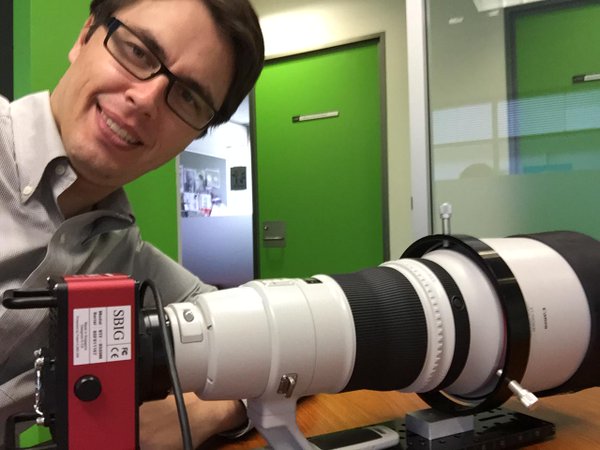 Dr Lee Spitler
Senior Lecturer, Macquarie Uni
versity and Australian Astronomical Observatory
I led image analysis for the
ZFOURGE survey,
a 45-night campaign over 2 years on the 6.5-metre Magellan Baade telescope
in Chile. We cataloged ~60,000 galaxies, including galaxies as far as 13 bi
llion light years. This is the most precise study of the distant unive
rse ever conducted.
As a part of ZFOURGE, I discovered one of the most <
a href="https://arxiv.org/abs/1112.2691" rel="nofollow" style="color: #3333
33;">distant galaxy clusters. This fascinating galaxy "city" triggered
a new observational campaign named
ZFIRE using the 10-me
tre Keck telescopes. We are looking for signs that the crowded environment
of a galaxy city impacted the galaxies within it.
My PhD work focused on anal
ysing some of the best imaging ever taken of nearby galaxies from the Subar
u and Hubble Space Telescopes for the
SLUGGS project. My imaging
lead to the discovery of many thousands of globular star clusters, which we
targeted with the Keck telescope to understand how much dark matter is in
these galaxies.
Dr Spitler r
ecieved a BSc with Honors in Computer Science from the University of Califo
rnia, Santa Cruz, USA, and a PhD in Astrophysics from Swinburne U
niversity, Melbourne, Australia
In 2015, Dr Spitler won the M
acquarie University award for Research Excellence for Early Career Research
er, and was nominated as a finalist for a 2015 Eureka Prize
DTSTAMP:20261006T032817
DTSTART;TZID=Australia/Sydney:20180405T193000
DTEND;TZID=Australia/Sydney:20180405T213000
SEQUENCE:0
TRANSP:OPAQUE
END:VEVENT
END:VCALENDAR