BEGIN:VCALENDAR
VERSION:2.0
PRODID:-//jEvents 2.0 for Joomla//EN
CALSCALE:GREGORIAN
METHOD:PUBLISH
BEGIN:VTIMEZONE
TZID:Australia/Sydney
BEGIN:STANDARD
DTSTART:20180731T193000
RDATE:20181007T030000
TZOFFSETFROM:+1100
TZOFFSETTO:+1000
TZNAME:Australia/Sydney AEST
END:STANDARD
BEGIN:STANDARD
DTSTART:20190407T020000
RDATE:20191006T030000
TZOFFSETFROM:+1100
TZOFFSETTO:+1000
TZNAME:Australia/Sydney AEST
END:STANDARD
BEGIN:STANDARD
DTSTART:20200405T020000
RDATE:20201004T030000
TZOFFSETFROM:+1100
TZOFFSETTO:+1000
TZNAME:Australia/Sydney AEST
END:STANDARD
BEGIN:STANDARD
DTSTART:20210404T020000
RDATE:20211003T030000
TZOFFSETFROM:+1100
TZOFFSETTO:+1000
TZNAME:Australia/Sydney AEST
END:STANDARD
BEGIN:STANDARD
DTSTART:20220403T020000
RDATE:20221002T030000
TZOFFSETFROM:+1100
TZOFFSETTO:+1000
TZNAME:Australia/Sydney AEST
END:STANDARD
BEGIN:STANDARD
DTSTART:20230402T020000
RDATE:20231001T030000
TZOFFSETFROM:+1100
TZOFFSETTO:+1000
TZNAME:Australia/Sydney AEST
END:STANDARD
BEGIN:STANDARD
DTSTART:20240407T020000
RDATE:20241006T030000
TZOFFSETFROM:+1100
TZOFFSETTO:+1000
TZNAME:Australia/Sydney AEST
END:STANDARD
BEGIN:STANDARD
DTSTART:20250406T020000
RDATE:20251005T030000
TZOFFSETFROM:+1100
TZOFFSETTO:+1000
TZNAME:Australia/Sydney AEST
END:STANDARD
BEGIN:STANDARD
DTSTART:20260405T020000
RDATE:20261004T030000
TZOFFSETFROM:+1100
TZOFFSETTO:+1000
TZNAME:Australia/Sydney AEST
END:STANDARD
BEGIN:STANDARD
DTSTART:20270404T020000
RDATE:20271003T030000
TZOFFSETFROM:+1100
TZOFFSETTO:+1000
TZNAME:Australia/Sydney AEST
END:STANDARD
BEGIN:STANDARD
DTSTART:20280402T020000
RDATE:20281001T030000
TZOFFSETFROM:+1100
TZOFFSETTO:+1000
TZNAME:Australia/Sydney AEST
END:STANDARD
BEGIN:DAYLIGHT
DTSTART:20181007T030000
RDATE:20190407T020000
TZOFFSETFROM:+1000
TZOFFSETTO:+1100
TZNAME:Australia/Sydney AEDT
END:DAYLIGHT
BEGIN:DAYLIGHT
DTSTART:20191006T030000
RDATE:20200405T020000
TZOFFSETFROM:+1000
TZOFFSETTO:+1100
TZNAME:Australia/Sydney AEDT
END:DAYLIGHT
BEGIN:DAYLIGHT
DTSTART:20201004T030000
RDATE:20210404T020000
TZOFFSETFROM:+1000
TZOFFSETTO:+1100
TZNAME:Australia/Sydney AEDT
END:DAYLIGHT
BEGIN:DAYLIGHT
DTSTART:20211003T030000
RDATE:20220403T020000
TZOFFSETFROM:+1000
TZOFFSETTO:+1100
TZNAME:Australia/Sydney AEDT
END:DAYLIGHT
BEGIN:DAYLIGHT
DTSTART:20221002T030000
RDATE:20230402T020000
TZOFFSETFROM:+1000
TZOFFSETTO:+1100
TZNAME:Australia/Sydney AEDT
END:DAYLIGHT
BEGIN:DAYLIGHT
DTSTART:20231001T030000
RDATE:20240407T020000
TZOFFSETFROM:+1000
TZOFFSETTO:+1100
TZNAME:Australia/Sydney AEDT
END:DAYLIGHT
BEGIN:DAYLIGHT
DTSTART:20241006T030000
RDATE:20250406T020000
TZOFFSETFROM:+1000
TZOFFSETTO:+1100
TZNAME:Australia/Sydney AEDT
END:DAYLIGHT
BEGIN:DAYLIGHT
DTSTART:20251005T030000
RDATE:20260405T020000
TZOFFSETFROM:+1000
TZOFFSETTO:+1100
TZNAME:Australia/Sydney AEDT
END:DAYLIGHT
BEGIN:DAYLIGHT
DTSTART:20261004T030000
RDATE:20270404T020000
TZOFFSETFROM:+1000
TZOFFSETTO:+1100
TZNAME:Australia/Sydney AEDT
END:DAYLIGHT
BEGIN:DAYLIGHT
DTSTART:20271003T030000
RDATE:20280402T020000
TZOFFSETFROM:+1000
TZOFFSETTO:+1100
TZNAME:Australia/Sydney AEDT
END:DAYLIGHT
BEGIN:DAYLIGHT
DTSTART:20281001T030000
RDATE:20290401T020000
TZOFFSETFROM:+1000
TZOFFSETTO:+1100
TZNAME:Australia/Sydney AEDT
END:DAYLIGHT
END:VTIMEZONE
BEGIN:VEVENT
UID:975a959c7f839cd971be2b657827c3dc
CATEGORIES:Guest Speaker Night
CREATED:20190504T100847
SUMMARY:Guest Speaker - Dr Lee Spitler - Macquarie University
LOCATION:Green Point Observatory
DESCRIPTION:The Huntsman Telescope
In this talk I give an update about the <
a href="https://www.mq.edu.au/about/about-the-university/faculties-and-depa
rtments/faculty-of-science-and-engineering/departments-and-centres/departme
nt-of-physics-and-astronomy/facilities/huntsman-telescope" title="Huntsman
Telescope web site">Huntsman Telescope, a new astronomy observing syste
m that makes use of an array of Canon lenses to take images of extremely fa
int astronomical sources. I'll describe the science motivation, show prelim
inary data and give an update on how the commissioning of the system at Sid
ing Spring Observatory. I will also discuss ambitious plans to launch a sma
ll satellite into space and perform similar observations at infrared wavele
ngths of light.
 Dr Lee Spitler
<
h4>Senior Lecturer in Astronomy and Astrophysics, Macquarie University
My research aims to improve our understanding of how galaxies form and e
volve through cosmic times. Galaxies host all the really interesting things
about the universe -- stars, dust, life, etc -- so their study can tell us
a lot about the universe we live in.
I am also pursuing creative way
s to view the universe using new technology. This started with my efforts t
o set up the Huntsman Telescope, a southern hem
isphere version of the Dragonfly Telephoto Array, which uses off-the-shelf Canon telepho
to lenses to image extremely diffuse stellar structures. You can follow our
Huntsman project on Twitter and Facebook.
This expanded
into space, with my efforts to launch a similar single lens system into sp
ace with the Australian Space Eye.
We've merged this effort into the SkyHopper Space Telescope mission.
Dr Spitler received a BSc
with Honours in Computer Science from the University of California, Santa
Cruz, USA, and a PhD in Astrophysics from Swinburne University, M
elbourne, Australia
In 2015, Dr Spitler won the Macquarie Universit
y award for Research Excellence for Early Career Researcher, and was nomina
ted as a finalist for a 2015 Eureka Prize
X-ALT-DESC;FMTTYPE=text/html:The Huntsman Telescope
In this talk I give an update about the <
a href="https://www.mq.edu.au/about/about-the-university/faculties-and-depa
rtments/faculty-of-science-and-engineering/departments-and-centres/departme
nt-of-physics-and-astronomy/facilities/huntsman-telescope" title="Huntsman
Telescope web site">Huntsman Telescope, a new astronomy observing syste
m that makes use of an array of Canon lenses to take images of extremely fa
int astronomical sources. I'll describe the science motivation, show prelim
inary data and give an update on how the commissioning of the system at Sid
ing Spring Observatory. I will also discuss ambitious plans to launch a sma
ll satellite into space and perform similar observations at infrared wavele
ngths of light.
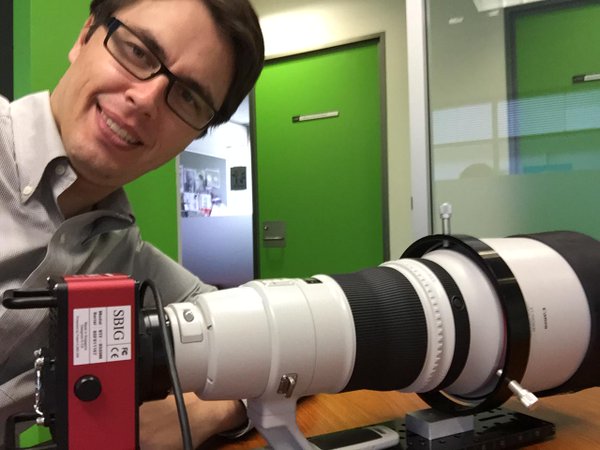 Dr Lee Spitler
Senior Lecturer in Astronomy and Astrophysics, M
acquarie University
My research aims to improve our understanding of
how galaxies form and evolve through cosmic times. Galaxies host all the r
eally interesting things about the universe -- stars, dust, life, etc -- so
their study can tell us a lot about the universe we live in.
I am al
so pursuing creative ways to view the universe using new technology. This s
tarted with my efforts to set up the Huntsman Teles
cope, a southern hemisphere version of the Dragonfly Telephoto Array, which uses off
-the-shelf Canon telephoto lenses to image extremely diffuse stellar struct
ures. You can follow our Huntsman project on Twitter and Facebook<
/a>.
This expanded into space, with my efforts to launch a similar si
ngle lens system into space with the A
ustralian Space Eye. We've merged this effort into the SkyHopper Space Telescope mission.
D
r Spitler received a BSc with Honours in Computer Science from the Universi
ty of California, Santa Cruz, USA, and a PhD in Astrophysics from
;Swinburne University, Melbourne, Australia
In 2015, Dr Spitler won
the Macquarie University award for Research Excellence for Early Career Re
searcher, and was nominated as a finalist for a 2015 Eureka Prize
DTSTAMP:20261005T071646
DTSTART;TZID=Australia/Sydney:20190801T193000
DTEND;TZID=Australia/Sydney:20190801T213000
SEQUENCE:0
TRANSP:OPAQUE
END:VEVENT
END:VCALENDAR